Watercolors & Oils by Sandra Smith-Poling
For availability of originals, please contact us. Matted print sizes are: 11x14, 16x20. Additional sizes may be available on request.
|
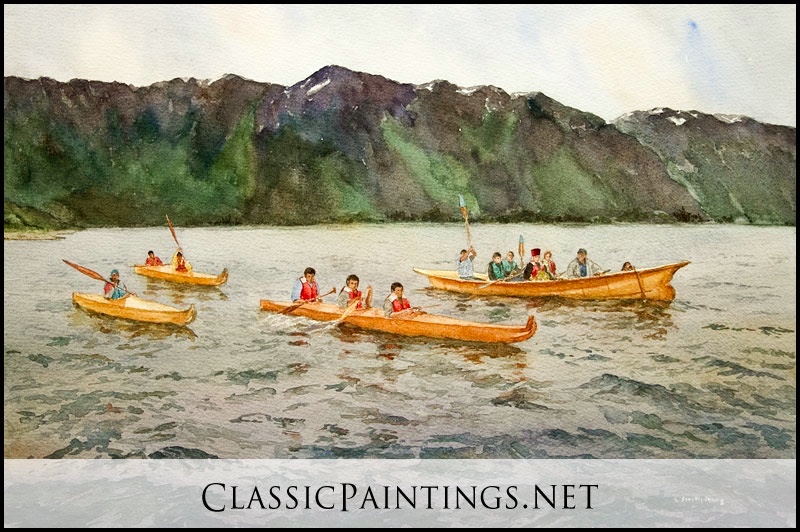
Angyak Christening
W/C My husband, Mitch Poling teaches Kayak (Baidarka-skin boat) and Angyak (open skin boat canoe) building every summer at the Chugach Spirit Camp* at Nuchek in Prince William Sound, Alaska. In July 2006, the angyak was launched after the blessing by the Russian Orthodox priest (seen in the angyak). The angyak is seen here accompanied by 1-hole, 2-hole and 3-hole kayaks built over the previous years by the students and camp staff under Mitch’s instruction. *Nuchek is the Chugach Tribe cultural camp on Hinchinbrook Island. This scene is similar to when Nuchek villagers greeted Captain Cook on May 12, 1778 on his first arrival. The villagers came to greet Cook’s ship in angyaks and kayaks. I have had the privilege to be the camp physician and also art instructor for several years.
Size:
$ 50.00
|

|
Baidarka Paddle Making
Watercolor: I captured one of the campers making the native bidarka paddle at the Nuuciq Spirit Camp.
Nuuciq has a Chugach spirit camp and every summer my husband teaches baidarka/angyak building and I am the camp doctor and teach baidarka models and native doll making. Today, Chugach Alaska Corporation hosts a Spirit Camp at Nuchek, Alaska. The program is as follows: "On the shores of Nuchek Island, approximately twenty minutes by air from Cordova, with the Prince William Sound, children and elders of the Chugach people spend time together to relive their heritage. The camp is designed to raise awareness of the origin and history of the people in the Prince William Sound and to heighten awareness of their history and culture. Activities include gathering and preparing subsistence foods, language lessons, woodcarving, beading, traditional singing, and dancing. Storytelling with Elders provides important lessons in culture, history, and learning the values of the Chugach community."* Nuchek is an Alutiiq word that means the "last land before the open water." The Chugach people inhabited Nuchek long before it was "discovered" by Russian and European settlers in the 18th century. As a protected port at a wide entry point to Prince William Sound, Nuchek quickly became a center of commercial activity during its early settlement by European explorers. Many nations claimed the area. The invention of steam engines and the decline in the trade of sea otter pelts led to Nuchek's ultimate abandonment in 1925. 18th Century Nuchek A number of European explorers seeking new territory in the northern hemisphere landed on Hinchinbrook Island in the late 18th century. The English Captain, James Cook, dropped anchor in Prince William Sound at Nuchek, Hinchinbrook Island, on May 12, 1778, and the following year, Spanish Lieutenant Inacio Aretega, dropped anchor in Port Etches (Nuchek). Ultimately, however, Russian settlers maintained the longest lasting imperial presence during this era. In 1799, the Russian American Company (RAC) was granted exclusive trading rights in Russian North America by their government. During this time, it was customary for Russian settlers to pay the Chugach chiefs a salary in exchange for time spent hunting sea otters. This practice encouraged reliance on the trading post for other supplies and slowly eroded the subsistence economy of the Chugach. Another reason for Nuchek's declining popularity was trade. It had been a center for sea otter trading, which was a dying industry. As a result, the trade center of the Sound shifted away from Nuchek to places like Valdez and Cordova where the fishing industry was growing
Size:
$ 50.00
|

|
Blowing the Seal Stomach, Nuchek
Watercolor: Subsistence learning at Nuchek. Here Ella is blowing up the seal stomach as Diane helps and looks on. Ella's grandson watches the proceedings.
Today, Chugach Alaska Corporation hosts a Spirit Camp at Nuchek. Chugach Alaska describes the program as follows: "On the shores of Nuchek Island, approximately twenty minutes by air from Cordova, with the Prince William Sound, children and elders of the Chugach people spend time together to relive their heritage. The camp is designed to raise awareness of the origin and history of the people in the Prince William Sound and to heighten awareness of their history and culture. Activities include gathering and preparing subsistence foods, language lessons, woodcarving, beading, traditional singing, and dancing. Storytelling with Elders provides important lessons in culture, history, and learning the values of the Chugach community."* Nuchek is an Alutiiq word that means the "last land before the open water." The Chugach people inhabited Nuchek long before it was "discovered" by Russian and European settlers in the 18th century. As a protected port at a wide entry point to Prince William Sound, Nuchek quickly became a center of commercial activity during its early settlement by European explorers. Many nations claimed the area. The invention of steam engines and the decline in the trade of sea otter pelts led to Nuchek's ultimate abandonment in 1925. 18th Century Nuchek A number of European explorers seeking new territory in the northern hemisphere landed on Hinchinbrook Island in the late 18th century. The English Captain, James Cook, dropped anchor in Prince William Sound at Nuchek, Hinchinbrook Island, on May 12, 1778, and the following year, Spanish Lieutenant Inacio Aretega, dropped anchor in Port Etches (Nuchek). Ultimately, however, Russian settlers maintained the longest lasting imperial presence during this era. In 1799, the Russian American Company (RAC) was granted exclusive trading rights in Russian North America by their government. During this time, it was customary for Russian settlers to pay the Chugach chiefs a salary in exchange for time spent hunting sea otters. This practice encouraged reliance on the trading post for other supplies and slowly eroded the subsistence economy of the Chugach. Another reason for Nuchek's declining popularity was trade. It had been a center for sea otter trading, which was a dying industry. As a result, the trade center of the Sound shifted away from Nuchek to places like Valdez and Cordova where the fishing industry was growing
Size:
$ 50.00
|
|
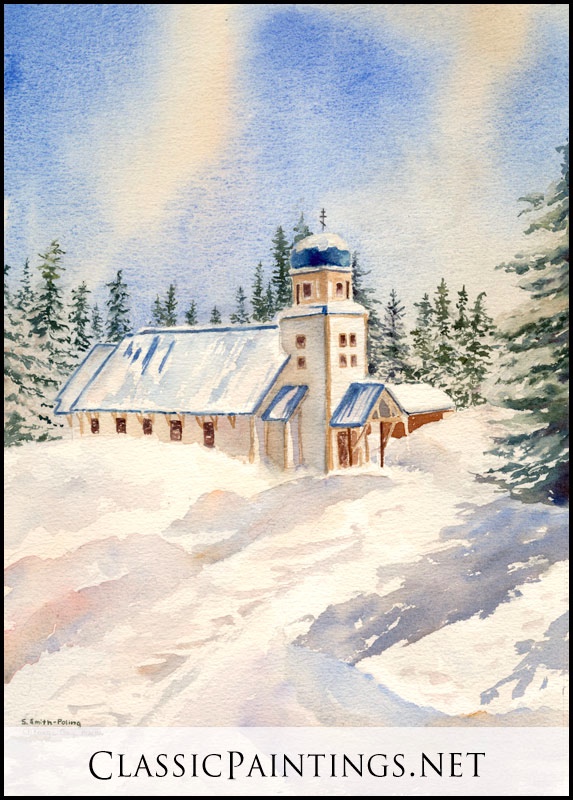
Chenega Bay Russian Orthodox Chapel
Watercolor: SUBJECT: The Chenega Bay Russian Orthodox Church provided a winter wonderland to paint. My husband, Mitch Poling and I spend a month during the winter teaching the high school students native Baidarka (Kayak) building. In the month we taught and helped them build three, 3-hole Baiddarkas.
The Chugach Alutiiq village of Chenega Bay, which was established only after the Good Friday earthquake destroyed the original community on Chenega Island to the north. The original village of Chenega, located on Chenega Island, was destroyed in 1964 by a tsunami from the Good Friday earthquake, which killed a third of the 68 people who then lived there. Some residents moved into a refugee camp; others moved to other towns. In 1982, one family moved to Evans Island and between 1984-1991 about 26 other families migrated to the new location, now called Chenega Bay. Former and current Chenega residents gathered each Good Friday to remember the dead of Chenega. On the 25th Good Friday after the earthquake, in 1989, the oil tanker Exxon Valdez ran aground in Prince William Sound, causing an oil spill that again devastated Chenega and other places around the area economically.
Size:
$ 50.00
|

|
Chenega Bay Russian Orthodox Chapel
Pen and Ink with watercolor wash: Painted from the Village Council while building Baidarkas. During the winter of 2012, Mitch Poling, my husband taught the school children and some of the village elders how to build their native Baidarkas. Three of them were build during this visit. The old village of Chenega was destroyed in the tsunami in 1964. The village was rebuild on Evans Island about 30 miles from the original island of Chenega. The village built this chapel.
Size:
$ 15.00
|

|
Evening Paddle at Nuchek, Alaska
Jerry O’Brian was paddling this three man baidarka one evening at Nuchek. The dramatic sky and yet the stillness were intoxicating to the eye and just begged to be painted. My husband Mitch Poling taught baidarka building classes and I was the camp doctor and taught model baidarka and doll making.
Today, Chugach Alaska Corporation hosts a Spirit Camp at Nuchek. Chugach Alaska describes the program as follows: "On the shores of Nuchek Island, approximately twenty minutes by air from Cordova, with the Prince William Sound, children and elders of the Chugach people spend time together to relive their heritage. The camp is designed to raise awareness of the origin and history of the people in the Prince William Sound and to heighten awareness of their history and culture. Activities include gathering and preparing subsistence foods, language lessons, woodcarving, beading, traditional singing, and dancing. Storytelling with Elders provides important lessons in culture, history, and learning the values of the Chugach community."* Nuchek is an Alutiiq word that means the "last land before the open water." The Chugach people inhabited Nuchek long before it was "discovered" by Russian and European settlers in the 18th century. As a protected port at a wide entry point to Prince William Sound, Nuchek quickly became a center of commercial activity during its early settlement by European explorers. Many nations claimed the area. The invention of steam engines and the decline in the trade of sea otter pelts led to Nuchek's ultimate abandonment in 1925. 18th Century Nuchek A number of European explorers seeking new territory in the northern hemisphere landed on Hinchinbrook Island in the late 18th century. The English Captain, James Cook, dropped anchor in Prince William Sound at Nuchek, Hinchinbrook Island, on May 12, 1778, and the following year, Spanish Lieutenant Inacio Aretega, dropped anchor in Port Etches (Nuchek). Ultimately, however, Russian settlers maintained the longest lasting imperial presence during this era. In 1799, the Russian American Company (RAC) was granted exclusive trading rights in Russian North America by their government. During this time, it was customary for Russian settlers to pay the Chugach chiefs a salary in exchange for time spent hunting sea otters. This practice encouraged reliance on the trading post for other supplies and slowly eroded the subsistence economy of the Chugach. Another reason for Nuchek's declining popularity was trade. It had been a center for sea otter trading, which was a dying industry. As a result, the trade center of the Sound shifted a
Size:
$ 50.00
|

|
Gray's Log Cabin, Juneau
W/C David and Kristin Gray’s log cabin in Lena Cove, Juneau, Alaska. This is an historic log cabin that has been in the Gray’s family for generations. My husband and I spent three delightful days at their house for the 50th Juneau-Douglas High School Reunion for the Gray’s and my husband, Mitch Poling.
Size:
$ 50.00
|
|
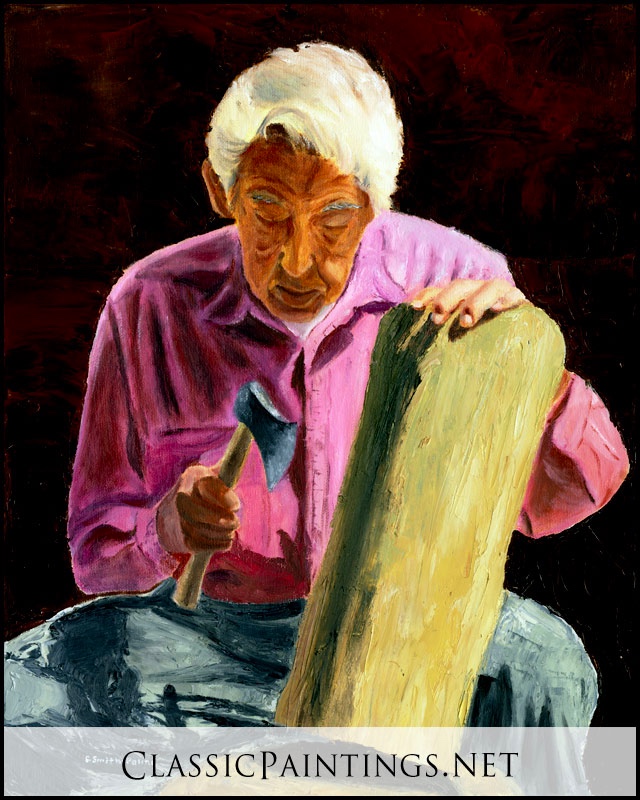
Henry Makarka
Watercolor: Henry Makarka is a revered Elder at Nuuciq and a good friend. Here he is carving a mask.
Today, Chugach Alaska Corporation hosts a Spirit Camp at Nuchek. Chugach Alaska describes the program as follows: "On the shores of Nuchek Island, approximately twenty minutes by air from Cordova, with the Prince William Sound, children and elders of the Chugach people spend time together to relive their heritage. The camp is designed to raise awareness of the origin and history of the people in the Prince William Sound and to heighten awareness of their history and culture. Activities include gathering and preparing subsistence foods, language lessons, woodcarving, beading, traditional singing, and dancing. Storytelling with Elders provides important lessons in culture, history, and learning the values of the Chugach community."* Nuchek is an Alutiiq word that means the "last land before the open water." The Chugach people inhabited Nuchek long before it was "discovered" by Russian and European settlers in the 18th century. As a protected port at a wide entry point to Prince William Sound, Nuchek quickly became a center of commercial activity during its early settlement by European explorers. Many nations claimed the area. The invention of steam engines and the decline in the trade of sea otter pelts led to Nuchek's ultimate abandonment in 1925. 18th Century Nuchek A number of European explorers seeking new territory in the northern hemisphere landed on Hinchinbrook Island in the late 18th century. The English Captain, James Cook, dropped anchor in Prince William Sound at Nuchek, Hinchinbrook Island, on May 12, 1778, and the following year, Spanish Lieutenant Inacio Aretega, dropped anchor in Port Etches (Nuchek). Ultimately, however, Russian settlers maintained the longest lasting imperial presence during this era. In 1799, the Russian American Company (RAC) was granted exclusive trading rights in Russian North America by their government. During this time, it was customary for Russian settlers to pay the Chugach chiefs a salary in exchange for time spent hunting sea otters. This practice encouraged reliance on the trading post for other supplies and slowly eroded the subsistence economy of the Chugach. Another reason for Nuchek's declining popularity was trade. It had been a center for sea otter trading, which was a dying industry. As a result, the trade center of the Sound shifted away from Nuchek to places like Valdez and Cordova where the fishing industry was growing
Size:
$ 50.00
|

|
Mount Ripinski, Haines, Alaska
W/C Haines Alaska was the setting for this painting. The mountain is a popular hiking destination. John and Lucy Poling built their house near the foot of the mountain, just about at the center of this painting.
Size:
$ 50.00
|

|
Humpback Visits Nuchek
W/C A pod of humpback whales came right up to our boat and dove beneath us just along Nuchek, Prince William Sound, Alaska. We were floating with the engine off and they were very curious, especially this one that I painted. Nuchek currently has a Chugach spirit camp every summer and my husband, Mitch Poling, teaches Baidarka building and I am the camp doctor and teach baidarka model and native doll making
Nuchek is an alutiiq word that means the “last land before open water”. The Chugach people inhabited Nuchek long before it was “discovered” by Russian and European settlers in the 18th century.
Size:
$ 50.00
|

|
John Christianson
Watercolor: Painted on Commission from Pat Christianson from a photo of John as a young man. I met John and Pat while helping teach and build Baidarkas with my husband Mitch in Chenega Bay, Alaska. I found his face fascinating to paint but also found John and Pat interesting and fascinating people.
Size:
$ 50.00
|

|
Late Afternoon Kayaking
W/C On a late summer afternoon in the lagoon at Nuchek, our friends are seen paddling the baidarkas that were built at the camp. It was a beautiful, restful paddle. The salmon were jumping and sometimes we can see a raft of sea otters.
Size:
$ 50.00
|

|
McPhetres Cabin, Juneau
The Samuel A. McPhetre’s Cabin, at Tee harbor, Juneau, Alaska. Built about 1950.
Size:
$ 50.00
|
|
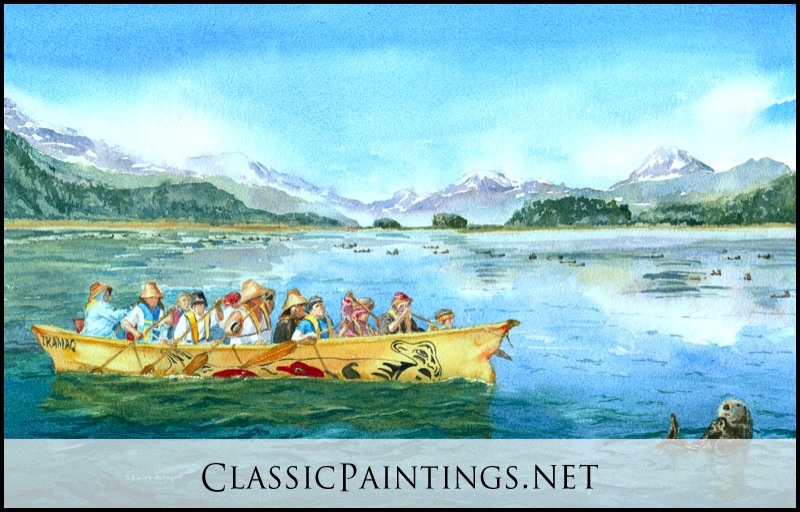
Otter and Ikamaq Angyak (Canoe)
W/C The Ikamaq (sea otter in Alutiiq ) is the name for the Angyak (skin and frame canoe) that was built by the BRIDGE native Alutiiq people currently living in Puget Sound. It was built under the guidance of Mitch Poling to participate in the 2010 annual Canoe Journey in Puget Sound. She is seen here in an allegorical return to her roots at Nuchek, Alaska where she is surrounded by rafts of sea otters.
Size:
$ 50.00
|
|
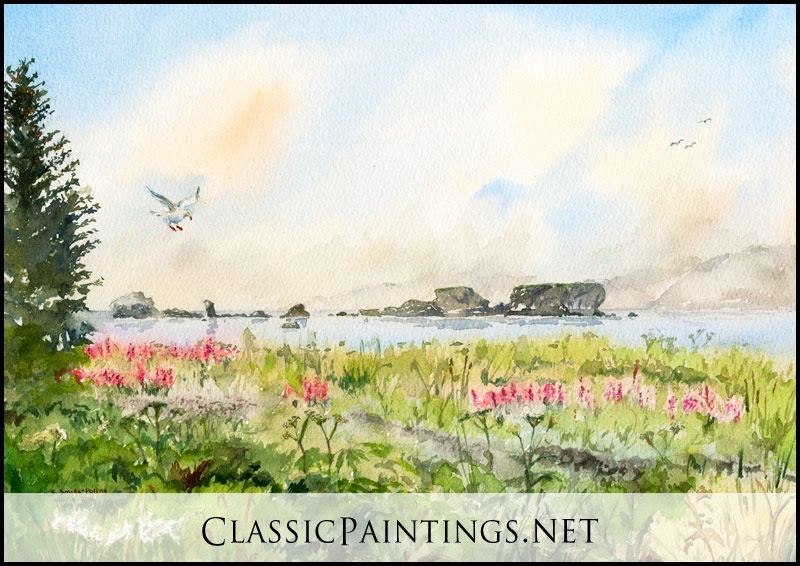
Porpoise Rocks
Watercolor: This is the view from Walter’s cabin. The fireweed and wild celery add interesting color and texture to the scene. Only seagulls were out on this day. Usually oyster catchers, ravens and eagles are about. It is very peaceful looking at the changing sky, water and reflections.
Today, Chugach Alaska Corporation hosts a Spirit Camp at Nuchek. Chugach Alaska describes the program as follows: "On the shores of Nuchek Island, approximately twenty minutes by air from Cordova, with the Prince William Sound, children and elders of the Chugach people spend time together to relive their heritage. The camp is designed to raise awareness of the origin and history of the people in the Prince William Sound and to heighten awareness of their history and culture. Activities include gathering and preparing subsistence foods, language lessons, woodcarving, beading, traditional singing, and dancing. Storytelling with Elders provides important lessons in culture, history, and learning the values of the Chugach community."* Nuchek is an Alutiiq word that means the "last land before the open water." The Chugach people inhabited Nuchek long before it was "discovered" by Russian and European settlers in the 18th century. As a protected port at a wide entry point to Prince William Sound, Nuchek quickly became a center of commercial activity during its early settlement by European explorers. Many nations claimed the area. The invention of steam engines and the decline in the trade of sea otter pelts led to Nuchek's ultimate abandonment in 1925. 18th Century Nuchek A number of European explorers seeking new territory in the northern hemisphere landed on Hinchinbrook Island in the late 18th century. The English Captain, James Cook, dropped anchor in Prince William Sound at Nuchek, Hinchinbrook Island, on May 12, 1778, and the following year, Spanish Lieutenant Inacio Aretega, dropped anchor in Port Etches (Nuchek). Ultimately, however, Russian settlers maintained the longest lasting imperial presence during this era. In 1799, the Russian American Company (RAC) was granted exclusive trading rights in Russian North America by their government. During this time, it was customary for Russian settlers to pay the Chugach chiefs a salary in exchange for time spent hunting sea otters. This practice encouraged reliance on the trading post for other supplies and slowly eroded the subsistence economy of the Chugach. Another reason for Nuchek's declining popularity was trade. It had been a center for sea otter trading, which was a dying industry. As a result, the trade center of the Sound shifted away from Nuchek to places like Valdez and Cordova where the fishing industry was growing
Size:
$ 50.00
|

|
Russian Chapel, Nuchek
Watercolor: Over the years I have watched the building of this chapel. I remember the big day when the onion spires were placed on top. It is so very peaceful in the chapel and this day the lighting on the chapel just said “Paint Me”. My husband Mitch Poling teaches Baidarka building and I am the camp doctor and teach model baidarka and doll making.
Today, Chugach Alaska Corporation hosts a Spirit Camp at Nuchek. Chugach Alaska describes the program as follows: "On the shores of Nuchek Island, approximately twenty minutes by air from Cordova, with the Prince William Sound, children and elders of the Chugach people spend time together to relive their heritage. The camp is designed to raise awareness of the origin and history of the people in the Prince William Sound and to heighten awareness of their history and culture. Activities include gathering and preparing subsistence foods, language lessons, woodcarving, beading, traditional singing, and dancing. Storytelling with Elders provides important lessons in culture, history, and learning the values of the Chugach community."* Nuchek is an Alutiiq word that means the "last land before the open water." The Chugach people inhabited Nuchek long before it was "discovered" by Russian and European settlers in the 18th century. As a protected port at a wide entry point to Prince William Sound, Nuchek quickly became a center of commercial activity during its early settlement by European explorers. Many nations claimed the area. The invention of steam engines and the decline in the trade of sea otter pelts led to Nuchek's ultimate abandonment in 1925. 18th Century Nuchek A number of European explorers seeking new territory in the northern hemisphere landed on Hinchinbrook Island in the late 18th century. The English Captain, James Cook, dropped anchor in Prince William Sound at Nuchek, Hinchinbrook Island, on May 12, 1778, and the following year, Spanish Lieutenant Inacio Aretega, dropped anchor in Port Etches (Nuchek). Ultimately, however, Russian settlers maintained the longest lasting imperial presence during this era. In 1799, the Russian American Company (RAC) was granted exclusive trading rights in Russian North America by their government. During this time, it was customary for Russian settlers to pay the Chugach chiefs a salary in exchange for time spent hunting sea otters. This practice encouraged reliance on the trading post for other supplies and slowly eroded the subsistence economy of the Chugach. Another reason for Nuchek's declining popularity was trade. It had been a center for sea otter trading, which was a dying industry. As a result, the trade center of the Sound shifted away from Nuchek to places like Valdez and Cordova where the fishing industry was growing
Size:
$ 50.00
|
|
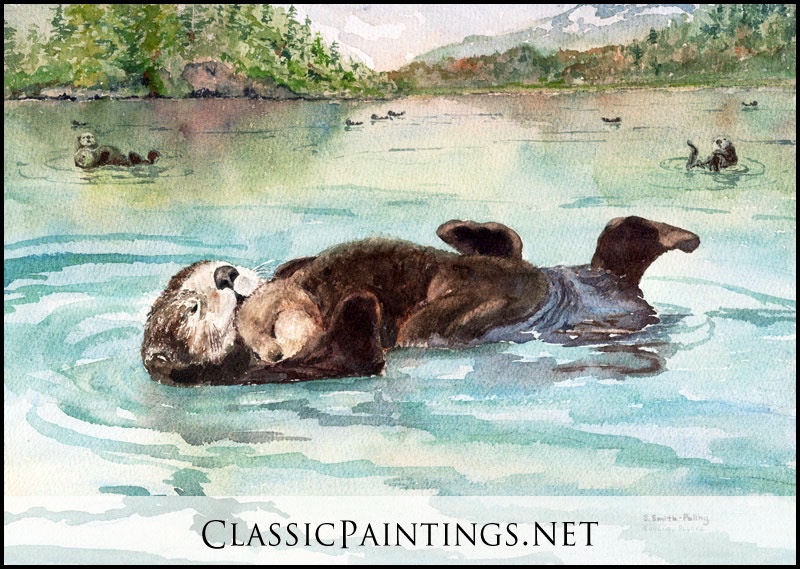
Mama and Baby Sea Otters, Prince William Sound, Alaska
Watercolor: The lagoon at Nuuciq(Nuchek), has hundreds of sea otters, many with their babies. It is such a pleasure to see them as we kayak or ride the skiff around Nuuciq. In the summer of 2011, we made a trek with the O’Brian family to honor Jerry O’Brian who was the caretaker at Nuuciq until his death. His family sprinkled his ashes at all his favorite places around Nuuciq. While fulfilling this honor, we saw many sea otter families. Nuuciq has a Chugach spirit camp and every summer my husband teaches baidarka/angyak building and I am the camp doctor and teach baidarka models and native doll making.
Today, Chugach Alaska Corporation hosts a Spirit Camp at Nuchek, Alaska. The program is as follows: "On the shores of Nuchek Island, approximately twenty minutes by air from Cordova, with the Prince William Sound, children and elders of the Chugach people spend time together to relive their heritage. The camp is designed to raise awareness of the origin and history of the people in the Prince William Sound and to heighten awareness of their history and culture. Activities include gathering and preparing subsistence foods, language lessons, woodcarving, beading, traditional singing, and dancing. Storytelling with Elders provides important lessons in culture, history, and learning the values of the Chugach community."* Nuchek is an Alutiiq word that means the "last land before the open water." The Chugach people inhabited Nuchek long before it was "discovered" by Russian and European settlers in the 18th century. As a protected port at a wide entry point to Prince William Sound, Nuchek quickly became a center of commercial activity during its early settlement by European explorers. Many nations claimed the area. The invention of steam engines and the decline in the trade of sea otter pelts led to Nuchek's ultimate abandonment in 1925. 18th Century Nuchek A number of European explorers seeking new territory in the northern hemisphere landed on Hinchinbrook Island in the late 18th century. The English Captain, James Cook, dropped anchor in Prince William Sound at Nuchek, Hinchinbrook Island, on May 12, 1778, and the following year, Spanish Lieutenant Inacio Aretega, dropped anchor in Port Etches (Nuchek). Ultimately, however, Russian settlers maintained the longest lasting imperial presence during this era. In 1799, the Russian American Company (RAC) was granted exclusive trading rights in Russian North America by their government. During this time, it was customary for Russian settlers to pay the Chugach chiefs a salary in exchange for time spent hunting sea otters. This practice encouraged reliance on the trading post for other supplies and slowly eroded the subsistence economy of the Chugach. Another reason for Nuchek's declining popularity was trade. It had been a center for sea otter trading, which was a dying industry. As a result, the trade center of the Sound shifted away from Nuchek to places like Valdez and Cordova where the fishing industry was growing
Size:
$ 50.00
|

|
Nucheck (Nuuciq) Lake with Beavers and Eagle
Watercolor: The lake at Nuuciq(Nuchek), has quite a beaver colony. It is such a pleasure to see them as we kayak or use the paddle boats in the lake. In the summer of 2012, the beavers were not only in the lake at at their dam, but one of them came down the river to the salt water lagoon. He was not happy with us interfearing with his fishing and made quite a ruckus with his tail to let us know! Nuuciq has a Chugach spirit camp and every summer my husband teaches baidarka/angyak building and I am the camp doctor and teach baidarka models and native doll making.
Today, Chugach Alaska Corporation hosts a Spirit Camp at Nuchek, Alaska. The program is as follows: "On the shores of Nuchek Island, approximately twenty minutes by air from Cordova, with the Prince William Sound, children and elders of the Chugach people spend time together to relive their heritage. The camp is designed to raise awareness of the origin and history of the people in the Prince William Sound and to heighten awareness of their history and culture. Activities include gathering and preparing subsistence foods, language lessons, woodcarving, beading, traditional singing, and dancing. Storytelling with Elders provides important lessons in culture, history, and learning the values of the Chugach community."* Nuchek is an Alutiiq word that means the "last land before the open water." The Chugach people inhabited Nuchek long before it was "discovered" by Russian and European settlers in the 18th century. As a protected port at a wide entry point to Prince William Sound, Nuchek quickly became a center of commercial activity during its early settlement by European explorers. Many nations claimed the area. The invention of steam engines and the decline in the trade of sea otter pelts led to Nuchek's ultimate abandonment in 1925. 18th Century Nuchek A number of European explorers seeking new territory in the northern hemisphere landed on Hinchinbrook Island in the late 18th century. The English Captain, James Cook, dropped anchor in Prince William Sound at Nuchek, Hinchinbrook Island, on May 12, 1778, and the following year, Spanish Lieutenant Inacio Aretega, dropped anchor in Port Etches (Nuchek). Ultimately, however, Russian settlers maintained the longest lasting imperial presence during this era. In 1799, the Russian American Company (RAC) was granted exclusive trading rights in Russian North America by their government. During this time, it was customary for Russian settlers to pay the Chugach chiefs a salary in exchange for time spent hunting sea otters. This practice encouraged reliance on the trading post for other supplies and slowly eroded the subsistence economy of the Chugach. Another reason for Nuchek's declining popularity was trade. It had been a center for sea otter trading, which was a dying industry. As a result, the trade center of the Sound shifted away from Nuchek to places like Valdez and Cordova where the fishing industry was growing
Size:
$ 50.00
|
|
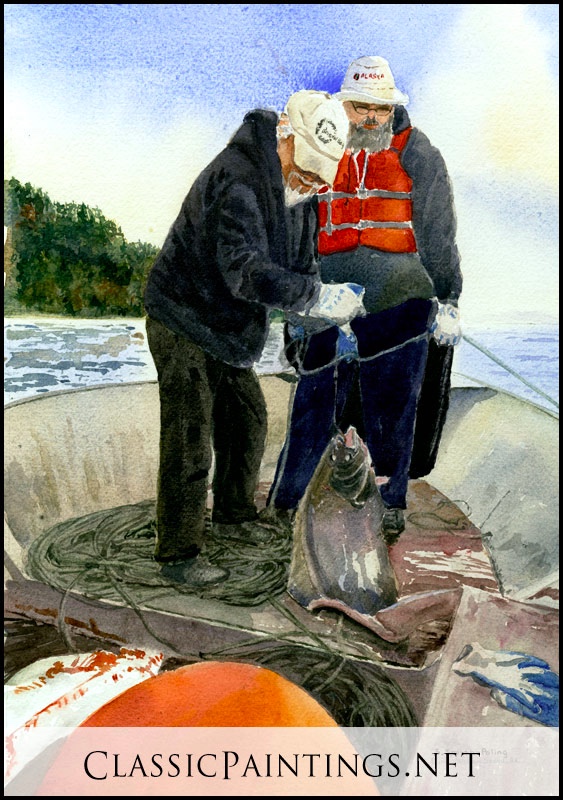
Pulling in the Halibut, Nuchek
Watercolor: Here are Tom Karshekoff and Father Christopher Stanton pulling in the halibut. Tom is from the Indian village of Nondalton, He has been a guide for bear and moose hunts for a long time as well as teaching subsistence living at Nuchek for many years. Father Christopher Stanton is a Russian Orthodox priest who comes to visit and supply spiritual guidance to those in need. I went out with them to see the humpback whales and watched them pull in the halibut line…we had wonderful halibut that night.
Today, Chugach Alaska Corporation hosts a Spirit Camp at Nuchek. Chugach Alaska describes the program as follows: "On the shores of Nuchek Island, approximately twenty minutes by air from Cordova, with the Prince William Sound, children and elders of the Chugach people spend time together to relive their heritage. The camp is designed to raise awareness of the origin and history of the people in the Prince William Sound and to heighten awareness of their history and culture. Activities include gathering and preparing subsistence foods, language lessons, woodcarving, beading, traditional singing, and dancing. Storytelling with Elders provides important lessons in culture, history, and learning the values of the Chugach community."* Nuchek is an Alutiiq word that means the "last land before the open water." The Chugach people inhabited Nuchek long before it was "discovered" by Russian and European settlers in the 18th century. As a protected port at a wide entry point to Prince William Sound, Nuchek quickly became a center of commercial activity during its early settlement by European explorers. Many nations claimed the area. The invention of steam engines and the decline in the trade of sea otter pelts led to Nuchek's ultimate abandonment in 1925. 18th Century Nuchek A number of European explorers seeking new territory in the northern hemisphere landed on Hinchinbrook Island in the late 18th century. The English Captain, James Cook, dropped anchor in Prince William Sound at Nuchek, Hinchinbrook Island, on May 12, 1778, and the following year, Spanish Lieutenant Inacio Aretega, dropped anchor in Port Etches (Nuchek). Ultimately, however, Russian settlers maintained the longest lasting imperial presence during this era. In 1799, the Russian American Company (RAC) was granted exclusive trading rights in Russian North America by their government. During this time, it was customary for Russian settlers to pay the Chugach chiefs a salary in exchange for time spent hunting sea otters. This practice encouraged reliance on the trading post for other supplies and slowly eroded the subsistence economy of the Chugach. Another reason for Nuchek's declining popularity was trade. It had been a center for sea otter trading, which was a dying industry. As a result, the trade center of the Sound shifted away from Nuchek to places like Valdez and Cordova where the fishing industry was growing
Size:
$ 50.00
|
|
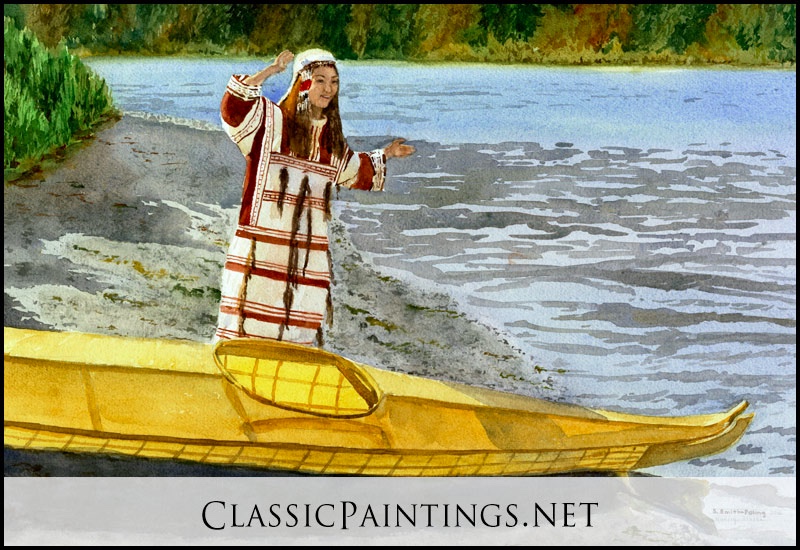
Alutiiq Dancer, Nucheck (Nuuciq)
Watercolor: One of the ladies at Nuuciq dressed in their native costume to dance by the Baidarka. We launched the latest Baidarka. Nuuciq has a Chugach spirit camp and every summer my husband teaches baidarka/angyak building and I am the camp doctor and teach baidarka models and native doll making.
Today, Chugach Alaska Corporation hosts a Spirit Camp at Nuchek, Alaska. The program is as follows: "On the shores of Nuchek Island, approximately twenty minutes by air from Cordova, with the Prince William Sound, children and elders of the Chugach people spend time together to relive their heritage. The camp is designed to raise awareness of the origin and history of the people in the Prince William Sound and to heighten awareness of their history and culture. Activities include gathering and preparing subsistence foods, language lessons, woodcarving, beading, traditional singing, and dancing. Storytelling with Elders provides important lessons in culture, history, and learning the values of the Chugach community."* Nuchek is an Alutiiq word that means the "last land before the open water." The Chugach people inhabited Nuchek long before it was "discovered" by Russian and European settlers in the 18th century. As a protected port at a wide entry point to Prince William Sound, Nuchek quickly became a center of commercial activity during its early settlement by European explorers. Many nations claimed the area. The invention of steam engines and the decline in the trade of sea otter pelts led to Nuchek's ultimate abandonment in 1925. 18th Century Nuchek A number of European explorers seeking new territory in the northern hemisphere landed on Hinchinbrook Island in the late 18th century. The English Captain, James Cook, dropped anchor in Prince William Sound at Nuchek, Hinchinbrook Island, on May 12, 1778, and the following year, Spanish Lieutenant Inacio Aretega, dropped anchor in Port Etches (Nuchek). Ultimately, however, Russian settlers maintained the longest lasting imperial presence during this era. In 1799, the Russian American Company (RAC) was granted exclusive trading rights in Russian North America by their government. During this time, it was customary for Russian settlers to pay the Chugach chiefs a salary in exchange for time spent hunting sea otters. This practice encouraged reliance on the trading post for other supplies and slowly eroded the subsistence economy of the Chugach. Another reason for Nuchek's declining popularity was trade. It had been a center for sea otter trading, which was a dying industry. As a result, the trade center of the Sound shifted away from Nuchek to places like Valdez and Cordova where the fishing industry was growing
Size:
$ 50.00
|

|
The Spirit of Alaska
Watercolor: SUBJECT: A young woman is enjoying the awesome beauty of Alaska at Nuuciq.
Nuuciq currently has a Chugach spirit camp every summer and my husband, Mitch Poling, teaches Baidarka building and I am the camp doctor and teach baidarka models and native doll making. Today, Chugach Alaska Corporation hosts a Spirit Camp at Nuuciq. Chugach Alaska describes the program as follows: "On the shores of Nuuciq Island, approximately twenty minutes by air from Cordova, with the Prince William Sound, children and elders of the Chugach people spend time together to relive their heritage. The camp is designed to raise awareness of the origin and history of the people in the Prince William Sound and to heighten awareness of their history and culture. Activities include gathering and preparing subsistence foods, language lessons, woodcarving, beading, traditional singing, and dancing. Storytelling with Elders provides important lessons in culture, history, and learning the values of the Chugach community."* Nuuciq (Nuchek) is an Alutiiq word that means the "last land before the open water." The Chugach people inhabited Nuchek long before it was "discovered" by Russian and European settlers in the 18th century. As a protected port at a wide entry point to Prince William Sound, Nuchek quickly became a center of commercial activity during its early settlement by European explorers. Many nations claimed the area. The invention of steam engines and the decline in the trade of sea otter pelts led to Nuchek's ultimate abandonment in 1925. 18th Century Nuchek A number of European explorers seeking new territory in the northern hemisphere landed on Hinchinbrook Island in the late 18th century. The English Captain, James Cook, dropped anchor in Prince William Sound at Nuchek, Hinchinbrook Island, on May 12, 1778, and the following year, Spanish Lieutenant Inacio Aretega, dropped anchor in Port Etches (Nuchek). Ultimately, however, Russian settlers maintained the longest lasting imperial presence during this era. In 1799, the Russian American Company (RAC) was granted exclusive trading rights in Russian North America by their government. During this time, it was customary for Russian settlers to pay the Chugach chiefs a salary in exchange for time spent hunting sea otters. This practice encouraged reliance on the trading post for other supplies and slowly eroded the subsistence economy of the Chugach. Another reason for Nuchek's declining popularity was trade. It had been a center for sea otter trading, which was a dying industry. As a result, the trade center of the Sound shifted away from Nuchek to places like Valdez and Cordova where the fishing industry was growing.
Size:
$ 50.00
|